Children's Educational Bargain Book Box
Children's Educational Bargain Book Box
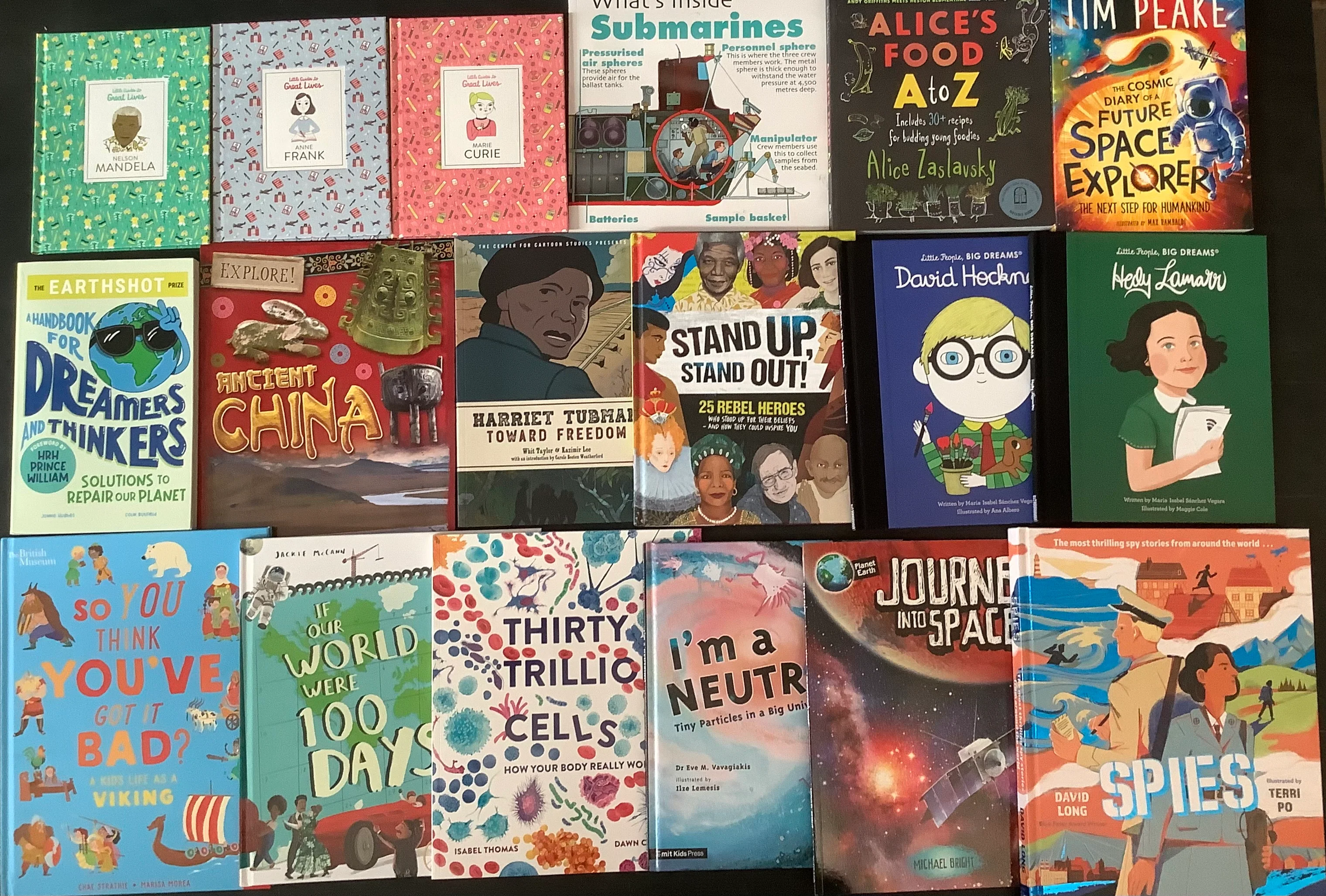
This collection features eighteen informative titles designed to engage young minds with history, science, and the lives of extraordinary individuals. The selection covers a broad educational spectrum, from the microscopic world of cellular biology and subatomic particles to the vast reaches of space exploration and environmental conservation. Readers will discover the daily lives of ancient civilizations alongside the stories of modern pioneers who stood up for their beliefs and reshaped the world through art, science, and social justice. This box provides a factual and visually engaging resource for curious students looking to expand their understanding of the planet and the people who have inhabited it.
-
British Museum: So You Think You've Got It Bad? A Kid's Life as a Viking by Chae Strathie This historical guide provides a humorous look at the challenging and often messy reality of growing up in the Viking Age. It explores traditional Norse housing, diet, and the specific chores expected of children during the era. Readers learn about the harsh climate and the unique customs that defined Viking society through engaging facts and illustrations. The narrative offers a lighthearted comparison between modern comforts and the survival skills required by young people over a thousand years ago.
-
Thirty Trillion Cells: How Your Body Really Works by Isabel Thomas This book takes a deep dive into the microscopic building blocks that make up the human body and their vital functions. It explains how specialized cells work together in complex systems to maintain health, fight off infections, and process energy. Complex biological concepts are broken down into accessible sections that highlight the incredible inner workings of our anatomy. It serves as a comprehensive introduction to human biology, emphasizing the scale and coordination of the trillions of units that sustain life.
-
Anne Frank by Isabel Thomas This biography chronicles the life of the young girl whose diary became a global symbol of hope and resilience during the Holocaust. It details her family’s move to the Secret Annex in Amsterdam and the daily realities of living in hiding from the Nazi regime. The narrative provides historical context for World War II while focusing on Anne’s personal growth, thoughts, and literary ambitions. It is a poignant and factual account of a life cut short that continues to inspire conversations about human rights and tolerance.
-
Nelson Mandela: Little Guides to Great Lives by Isabel Thomas This guide follows the life of the revolutionary leader who fought against apartheid and eventually became the first Black president of South Africa. It covers his early activism, his long years of imprisonment on Robben Island, and his unwavering commitment to peace and reconciliation. The book explains the historical significance of his struggle against racial segregation and his legacy as a global icon of justice. It is an inspiring look at how one individual's persistence can lead to monumental social and political change.
-
Marie Curie: Little Guides to Great Lives by Isabel Thomas This volume details the groundbreaking career of the scientist who discovered radioactivity and became the first woman to win a Nobel Prize. It tracks her journey from a determined student in Poland to a pioneering researcher in Paris who conducted life-changing work with radium. The biography highlights the obstacles she overcame in a male-dominated field and her lasting contributions to medicine and physics. Her story emphasizes the importance of curiosity, hard work, and the pursuit of scientific knowledge for the benefit of humanity.
-
Stand Up, Stand Out!: 25 rebel heroes who stood up for their beliefs by Kay Woodward This collection features twenty-five short biographies of individuals who challenged the status quo to fight for equality and justice. From political activists and environmentalists to sports icons, each entry focuses on a pivotal moment when the hero chose to take a stand. The book provides historical context for each struggle and offers insights into how these figures can inspire modern readers. It is a powerful exploration of courage and the various ways people can influence positive change in their communities.
-
Alice's Food A-Z by Alice Zaslavsky This culinary guide takes young readers on an alphabetical journey through the world of fresh produce, cooking techniques, and nutrition. Each entry provides interesting facts about specific ingredients alongside tips on how to prepare and enjoy them in healthy ways. The book encourages children to be curious about what they eat and to understand the origins of their food. It is an engaging resource for developing food literacy and building confidence in the kitchen through a vibrant and informative approach.
-
I'm a Neutrino: Tiny Particles in a Big Universe by Dr. Eve M. Vavagiakis This scientific picture book introduces the concept of neutrinos, the mysterious subatomic particles that pass through almost everything in the universe. It explains how these "ghost particles" are created in stars and what scientists are doing to detect and study them. The narrative uses poetic language and clear explanations to make complex physics accessible to a young audience. It fosters a sense of wonder about the invisible forces that shape our cosmos and the tools used to explore them.
-
The Earthshot Prize: A Handbook for Dreamers and Thinkers by HRH Prince William This handbook focuses on five ambitious goals to protect and restore the natural world by the end of the decade. It highlights innovative solutions and real-world projects aimed at repairing the climate, protecting nature, and cleaning our air and oceans. The book provides practical advice and inspiration for young environmentalists who want to contribute to a sustainable future. It serves as a hopeful and action-oriented guide for the next generation of thinkers dedicated to planet-saving technology.
-
The Cosmic Diary of a Future Space Explorer by Tim Peake Written by a real astronaut, this book provides an insider’s look at the training, technology, and daily life involved in space travel. It explores the future of humankind's journey to the Moon and Mars, detailing the scientific challenges of living in zero gravity. The narrative is structured as a diary, making the complex engineering and physics of space missions relatable and exciting. It encourages readers to imagine themselves as part of the next generation of explorers pushing the boundaries of the solar system.
-
Explore!: Ancient China by Izzi Howell This historical exploration takes readers back thousands of years to the banks of the Yellow River to discover the origins of Chinese civilization. It covers the rise of powerful dynasties, the construction of the Great Wall, and the invention of vital technologies like paper and gunpowder. The book examines daily life, religious beliefs, and the sophisticated social structures that allowed the empire to flourish for centuries. It is a factual and illustrated guide to the enduring legacy of one of the world's oldest cultures.
-
What's Inside?: Submarines by David West This technical guide uses detailed cutaway illustrations to show the internal mechanics and living quarters of different types of submarines. It explains the physics of buoyancy and how these vessels navigate the high-pressure environment of the deep ocean. The book covers both historical submersibles and modern nuclear submarines, detailing the specialized equipment used for research and defense. It provides a fascinating look at the engineering required to keep humans safe and operational beneath the waves for long periods.
-
Harriet Tubman: Toward Freedom by Kazimir Lee Presented in a graphic novel format, this biography tells the harrowing and heroic story of the most famous conductor of the Underground Railroad. It follows her escape from slavery and her subsequent missions to lead dozens of other enslaved people to freedom in the North. The book captures her bravery as a scout and spy for the Union Army and her lifelong dedication to the cause of abolition. This visual narrative brings the intensity and historical importance of her journey to life for a modern audience.
-
Planet Earth: Journey into Space by Michael Bright This book provides a visual overview of Earth’s place in the solar system and the unique conditions that allow life to thrive on our planet. It explores the different layers of the atmosphere, the moon’s influence on the tides, and the history of satellite technology. The narrative tracks how our understanding of the planet has evolved through space exploration and remote sensing. It is an informative resource for understanding the interconnected systems of Earth and the vast environment that surrounds it.
-
David Hockney: Volume 99 by Maria Isabel Sanchez Vegara This biography introduces young readers to one of the most influential British artists of the twentieth century and his vibrant, innovative style. It follows his journey from a young boy in Yorkshire to a world-renowned painter known for his colorful depictions of California life and nature. The book explores his constant experimentation with different mediums, from traditional oils to modern digital tablets. It is an inspiring look at the importance of seeing the world in new ways and the joy of lifelong creative exploration.
-
Hedy Lamarr: Volume 93 by Maria Isabel Sanchez Vegara This entry in the Little People, BIG DREAMS series tells the story of the Hollywood star who was also a brilliant inventor. It details her escape from pre-war Europe and her subsequent double life as a glamorous actress and a pioneering scientist. The narrative highlights her invention of frequency-hopping technology, which laid the groundwork for modern Wi-Fi and Bluetooth. Her story emphasizes that people are multifaceted and that genius can be found in the most unexpected places.
-
Spies by David Long This comprehensive history delves into the secret world of espionage, detailing the real-life missions, gadgets, and individuals who worked in the shadows. It covers famous intelligence operations from World War II through the Cold War, explaining the techniques used to gather and protect secrets. The book explores the moral complexities of spying and the vital role that intelligence plays in global events. It is a factual and gripping account of the bravery and cleverness required by those who live lives of deception for their countries.
-
If Our World Were 100 Days by Jackie McCann This book uses a clever mathematical concept to simplify the history and current state of the planet by imagining everything happened in just 100 days. It breaks down complex global statistics regarding population, resources, and historical events into digestible timeframes. By condensing the timeline, the narrative makes the impact of human development and environmental changes easier to visualize and understand. It is a unique and informative tool for teaching children about global scales, history, and the urgency of modern challenges.
Original: $56.53
-70%$56.53
$16.96Product Information
Product Information
Shipping & Returns
Shipping & Returns
Description
Children's Educational Bargain Book Box
This collection features eighteen informative titles designed to engage young minds with history, science, and the lives of extraordinary individuals. The selection covers a broad educational spectrum, from the microscopic world of cellular biology and subatomic particles to the vast reaches of space exploration and environmental conservation. Readers will discover the daily lives of ancient civilizations alongside the stories of modern pioneers who stood up for their beliefs and reshaped the world through art, science, and social justice. This box provides a factual and visually engaging resource for curious students looking to expand their understanding of the planet and the people who have inhabited it.
-
British Museum: So You Think You've Got It Bad? A Kid's Life as a Viking by Chae Strathie This historical guide provides a humorous look at the challenging and often messy reality of growing up in the Viking Age. It explores traditional Norse housing, diet, and the specific chores expected of children during the era. Readers learn about the harsh climate and the unique customs that defined Viking society through engaging facts and illustrations. The narrative offers a lighthearted comparison between modern comforts and the survival skills required by young people over a thousand years ago.
-
Thirty Trillion Cells: How Your Body Really Works by Isabel Thomas This book takes a deep dive into the microscopic building blocks that make up the human body and their vital functions. It explains how specialized cells work together in complex systems to maintain health, fight off infections, and process energy. Complex biological concepts are broken down into accessible sections that highlight the incredible inner workings of our anatomy. It serves as a comprehensive introduction to human biology, emphasizing the scale and coordination of the trillions of units that sustain life.
-
Anne Frank by Isabel Thomas This biography chronicles the life of the young girl whose diary became a global symbol of hope and resilience during the Holocaust. It details her family’s move to the Secret Annex in Amsterdam and the daily realities of living in hiding from the Nazi regime. The narrative provides historical context for World War II while focusing on Anne’s personal growth, thoughts, and literary ambitions. It is a poignant and factual account of a life cut short that continues to inspire conversations about human rights and tolerance.
-
Nelson Mandela: Little Guides to Great Lives by Isabel Thomas This guide follows the life of the revolutionary leader who fought against apartheid and eventually became the first Black president of South Africa. It covers his early activism, his long years of imprisonment on Robben Island, and his unwavering commitment to peace and reconciliation. The book explains the historical significance of his struggle against racial segregation and his legacy as a global icon of justice. It is an inspiring look at how one individual's persistence can lead to monumental social and political change.
-
Marie Curie: Little Guides to Great Lives by Isabel Thomas This volume details the groundbreaking career of the scientist who discovered radioactivity and became the first woman to win a Nobel Prize. It tracks her journey from a determined student in Poland to a pioneering researcher in Paris who conducted life-changing work with radium. The biography highlights the obstacles she overcame in a male-dominated field and her lasting contributions to medicine and physics. Her story emphasizes the importance of curiosity, hard work, and the pursuit of scientific knowledge for the benefit of humanity.
-
Stand Up, Stand Out!: 25 rebel heroes who stood up for their beliefs by Kay Woodward This collection features twenty-five short biographies of individuals who challenged the status quo to fight for equality and justice. From political activists and environmentalists to sports icons, each entry focuses on a pivotal moment when the hero chose to take a stand. The book provides historical context for each struggle and offers insights into how these figures can inspire modern readers. It is a powerful exploration of courage and the various ways people can influence positive change in their communities.
-
Alice's Food A-Z by Alice Zaslavsky This culinary guide takes young readers on an alphabetical journey through the world of fresh produce, cooking techniques, and nutrition. Each entry provides interesting facts about specific ingredients alongside tips on how to prepare and enjoy them in healthy ways. The book encourages children to be curious about what they eat and to understand the origins of their food. It is an engaging resource for developing food literacy and building confidence in the kitchen through a vibrant and informative approach.
-
I'm a Neutrino: Tiny Particles in a Big Universe by Dr. Eve M. Vavagiakis This scientific picture book introduces the concept of neutrinos, the mysterious subatomic particles that pass through almost everything in the universe. It explains how these "ghost particles" are created in stars and what scientists are doing to detect and study them. The narrative uses poetic language and clear explanations to make complex physics accessible to a young audience. It fosters a sense of wonder about the invisible forces that shape our cosmos and the tools used to explore them.
-
The Earthshot Prize: A Handbook for Dreamers and Thinkers by HRH Prince William This handbook focuses on five ambitious goals to protect and restore the natural world by the end of the decade. It highlights innovative solutions and real-world projects aimed at repairing the climate, protecting nature, and cleaning our air and oceans. The book provides practical advice and inspiration for young environmentalists who want to contribute to a sustainable future. It serves as a hopeful and action-oriented guide for the next generation of thinkers dedicated to planet-saving technology.
-
The Cosmic Diary of a Future Space Explorer by Tim Peake Written by a real astronaut, this book provides an insider’s look at the training, technology, and daily life involved in space travel. It explores the future of humankind's journey to the Moon and Mars, detailing the scientific challenges of living in zero gravity. The narrative is structured as a diary, making the complex engineering and physics of space missions relatable and exciting. It encourages readers to imagine themselves as part of the next generation of explorers pushing the boundaries of the solar system.
-
Explore!: Ancient China by Izzi Howell This historical exploration takes readers back thousands of years to the banks of the Yellow River to discover the origins of Chinese civilization. It covers the rise of powerful dynasties, the construction of the Great Wall, and the invention of vital technologies like paper and gunpowder. The book examines daily life, religious beliefs, and the sophisticated social structures that allowed the empire to flourish for centuries. It is a factual and illustrated guide to the enduring legacy of one of the world's oldest cultures.
-
What's Inside?: Submarines by David West This technical guide uses detailed cutaway illustrations to show the internal mechanics and living quarters of different types of submarines. It explains the physics of buoyancy and how these vessels navigate the high-pressure environment of the deep ocean. The book covers both historical submersibles and modern nuclear submarines, detailing the specialized equipment used for research and defense. It provides a fascinating look at the engineering required to keep humans safe and operational beneath the waves for long periods.
-
Harriet Tubman: Toward Freedom by Kazimir Lee Presented in a graphic novel format, this biography tells the harrowing and heroic story of the most famous conductor of the Underground Railroad. It follows her escape from slavery and her subsequent missions to lead dozens of other enslaved people to freedom in the North. The book captures her bravery as a scout and spy for the Union Army and her lifelong dedication to the cause of abolition. This visual narrative brings the intensity and historical importance of her journey to life for a modern audience.
-
Planet Earth: Journey into Space by Michael Bright This book provides a visual overview of Earth’s place in the solar system and the unique conditions that allow life to thrive on our planet. It explores the different layers of the atmosphere, the moon’s influence on the tides, and the history of satellite technology. The narrative tracks how our understanding of the planet has evolved through space exploration and remote sensing. It is an informative resource for understanding the interconnected systems of Earth and the vast environment that surrounds it.
-
David Hockney: Volume 99 by Maria Isabel Sanchez Vegara This biography introduces young readers to one of the most influential British artists of the twentieth century and his vibrant, innovative style. It follows his journey from a young boy in Yorkshire to a world-renowned painter known for his colorful depictions of California life and nature. The book explores his constant experimentation with different mediums, from traditional oils to modern digital tablets. It is an inspiring look at the importance of seeing the world in new ways and the joy of lifelong creative exploration.
-
Hedy Lamarr: Volume 93 by Maria Isabel Sanchez Vegara This entry in the Little People, BIG DREAMS series tells the story of the Hollywood star who was also a brilliant inventor. It details her escape from pre-war Europe and her subsequent double life as a glamorous actress and a pioneering scientist. The narrative highlights her invention of frequency-hopping technology, which laid the groundwork for modern Wi-Fi and Bluetooth. Her story emphasizes that people are multifaceted and that genius can be found in the most unexpected places.
-
Spies by David Long This comprehensive history delves into the secret world of espionage, detailing the real-life missions, gadgets, and individuals who worked in the shadows. It covers famous intelligence operations from World War II through the Cold War, explaining the techniques used to gather and protect secrets. The book explores the moral complexities of spying and the vital role that intelligence plays in global events. It is a factual and gripping account of the bravery and cleverness required by those who live lives of deception for their countries.
-
If Our World Were 100 Days by Jackie McCann This book uses a clever mathematical concept to simplify the history and current state of the planet by imagining everything happened in just 100 days. It breaks down complex global statistics regarding population, resources, and historical events into digestible timeframes. By condensing the timeline, the narrative makes the impact of human development and environmental changes easier to visualize and understand. It is a unique and informative tool for teaching children about global scales, history, and the urgency of modern challenges.